- Site navigation
- Pleiade Associates · Home
- Projects
- LOX Study (2013)
- PREVIOUS LOX Study (2003)
- About us...
- On The Pleiades...
- contact us
- Site map


PleiadeAssociates
NOTE: This study was superseded in 2013 by the LOX Study (2013), which was submitted to the Airports Commission in July 2013 as part of the ongoing review of long-term options for airport capacity.
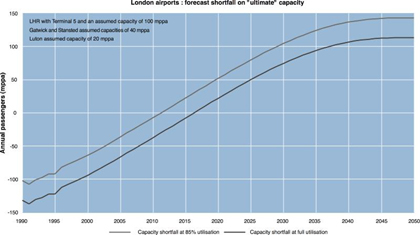
LOX (London Oxford Aiport) is a proposal for a new 4 runway airport in the Vale of the White Horse, Oxfordshire. Advanced in the recent Transport White Paper consultation as the "Best Practicable Environmental Option" to the impending crisis in airport capacity in the South East Region of the United Kingdom.
Following the South East and East of England Regional Air Service Study (SERAS) and the publication of the White Paper (The Future of Air Transport, December 2003 [note 2]) – a masterpiece of Whitehall weasel-worded obfuscation – Stansted Airport is set to become the third London airport. In the process the "Best Practicable Environmental Option", the LOX Project, was quietly strangled in the dark corridors of Whitehall, under the slumbering gaze of a press seemingly obsessed with the antics of 'harlots and varlets'. [note 3]
Annual Capacity:
Facilities:
Present value (3.5% discount rate):
To serve as an airport for Great Britain, rather than merely the South East region, the new airport is sited outside of the transportation 'shadow' cast by Greater London, with good motorway and rail links to central London, the Midlands, Northern England and the South West. Its close proximity to the area of "Managed Growth", the so-called economic "Golden triangle", to the west of Heathrow airport seeks to 'reinforce success' by augmenting the economic potential of this sub-region and thereby assisting in the maintenance of the Capital's status as a global centre.
The location of LOX to the west of the NATS London Terminal Manoeuvring Area also ensures that trans-atlantic and trans-polar flights would avoid many of the constrictions imposed by capacity limitations in the LTMA.
The combined environmental impacts of the project are assessed as significantly lower than any of the proposed options presented in Department for Transport's "The Future Development of Air Transport in the United Kingdom: South East: A National Consultation". Department for Transport. London, July 2002.
A strategic objective of the proposal is to disperse development away from the London metropolitan conurbation and its immediate 'fringe', whilst reinforcing the M4/M40 area of emerging economic growth. The proposal is to locate this major strategic development so as to extend its effects into the United Kingdom. It is not focused primarily on the de facto extension of the capital conurbation, in contrast to the objectives of the Thames Gateway strategy.
The comparatively low costs of the initial phases and the ability to ensure that growth could be closely and economically matched to demand would significantly reduce the risk that the project would require Public Sector financial support.
The report and figures as submitted to the Department for Transport are available here:
The LOX Report | Report in pdf files.
Report of the Inter-departmental Committee on the The Third London Aiport, CAP 199, 1963: Stansted recommended as the third London Airport.
Recommended reading: David McKie (1973). A sadly mismanaged affair, London, Croom Helm. ISBN 0 85664 096 4.
White Paper, 2003 - Review of London Oxford Airport.
The Best Practicable Environmental Option, 12th report of The Royal Commission on Environmental Pollution (1988). (Cm 310, ISBN 0 10 103102 5).
The offical response to the proposal is given below.
Extract from the White Paper: The Future of Air Transport, December 2003[1]
Chapter 11: South East Region: Alternative proposals
11.115 So far as the London Oxford proposal is concerned, it is accepted that the location of the airport in relation to centres of demand would mean that it could be well used without the need for market intervention by the Government. Nevertheless, the promoters accept that such a project could not be financed conventionally by the private sector. However, the net economic benefits of the airport with four runways by 2030 are estimated to be no greater than for a two-runway strategy at Stansted and Heathrow. There would be a need for substantial new investment in road and rail access, and there were significant doubts about the feasibility and capacity of the promoters' proposals in this regard. The proposal would require a very large landtake, including the loss of 23 Grade II listed buildings; and capacity might be constrained by the high chimney of Didcot power station.
11.116 In the light of these particular concerns, the evidence currently available to the Government, and all other relevant factors, the Government does not consider that any of the above proposals can be considered to offer a solution that is both superior to the preferred options for development of existing major airports, as previously described, and clearly viable within the timescale concerned.
Master Planning and airspace planning: Pleiade Associates.
Cost Planning and Project Management: Gardiner & Theobald.
Engineering, Transport, Economics & Planning, and Environment: see acknowledgement.
Ove Arup & Partners and Arup Economics & Planning contributed greatly to the engineering, transport, environmental impacts, economic and planning aspects of the LOX project from its inception through to mid 2000. Conflicting commercial interests emerged which led to their withdrawal from the Project Study Team: Arup are not presently associated with the project.
White Paper (2003): The Future of Air Transport (pdf document) and Hansard: Debate 16 December 2003.
Note 2“The LOX estimated [aircraft noise] contour areas are larger than those estimated for Cliffe, particularly at the lower noise levels [a]. The numbers affected by LOX [b] are higher than by Cliffe, but lower by large margins than the options at Stansted (28,000 within 57 dB contour of four runway airport in 2030) or Gatwick (31,000 within 57 dB contour of three runway airport in 2030).”
Source: Department for Transport (September 2003): commissioned report (unpublished).
Note a:
There is a difference between the DfT and the LOX study aircraft noise models & assumptions. Adjustment of LOX to the DfT basis reduces the impact to some 19,000 people within the 57 dB contour of the four runway airport in 2040.
Note b:
Less than 22,000 people within the 57 Leq dB contour of the four runway airport in 2040.
The larger area of LOX is a consequence of the inclusion of features not present in Stansted, such as, a large aircaft maintenance facility, extensive Runway End Safety Areas (RESA), a Rail Cargo interchange, on-site treatment of waste and sewage, etc. However the descriptions of the Stansted airport proposals in the National Consultation documents* are insufficiently detailed to make precise comparisions.
The area of the LOX airport proper, that is within its perimeter fence, is 19.5 km2 – Other land would be taken in addition to the LOX airport site, 6 km2 as a Nature reserve and 2.3 km2 Mixed land use development zone.
* Department for Transport (2002) Consultation (pdf document): The Future Development of Air Transport in the United Kingdom: South East: A National Consultation, London, HMSO.
❖ The LOX Report is freely available as PDF documents here.
Review of London Oxford Airport (PDF document), Halcrow (2003).
The implications and benefits of the LOX Project are discussed in a free sample chapter (pdf) from a reference publication on integrated transport:
Christopher J Blow (2005). Transport Terminals and Modal Interchanges. London. Architectural Press – Elsevier.
ISBN: 978-0-7506-5693-1
ISBN10: 0-7506-5693-X