Aux armes…
More strange than true: I never may believe
These antique fables, nor these fairy toys …And as imagination bodies forth
The forms of things unknown, the poet's pen
Turns them to shapes and gives to airy nothing
A local habitation and a name.William Shakespeare (c. 1595). A Midsummer Night's Dream.

Prologue
One more pebble cast on the mountain of internet trivia … being a fragment from one of the few surviving artistic practices of the Middle Ages, heraldry. This was once a minor glory of Medieval art but has long since faded to gaudy ostentation, along with its original taints of feudalism and brutality. Even so, vestiges of the strange beauty of a vanished world linger in the remnants. Whether or not any such traces can be found here, for many these anachronisms will offer only "airy nothings": yet tastes vary and others may find the odd morsel here and there.
Despite the digressions, what follows is merely an illustrated ramble through the scanty [antique fables] heraldic panoply of Alan Geal — an obscure and otherwise unadorned British commoner — and these often solemn but otherwise flippant commonplaces should not be taken as scholarship. This is not a treatise on English heraldry: if that is your object, then the following could be helpful
- Charles Boutell (1867). The Handbook to English Heraldry.
- Arthur Charles Fox-Davies (1909). A Complete Guide to Heraldry.
- Steen Clemmensen. Medieval Armorials.
- The College of Arms, London.
- The Heraldry Society.
The Arms and Crest
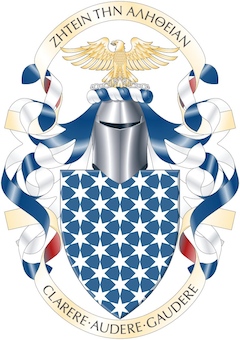
Blazon
Arms
Azure semy of Mullets of six points conjoined Argent.
Crest
On a Wreath Argent and Azure within a Circlet of Chain fracted Argent an Eagle wings expanded Or grasping in the talons the Chain.
Mantling
Azure doubled Argent.
These arcane terms are explained in a glossary.
Mottoes
Below the Arms:
CLARERE AUDERE GAUDERE
Be bright: be daring: be joyful.
Above the Crest:
ΖΗΤΕΙΝ ΤΗΝ ΑΛΗΘΕΙΑΝ
Seek the truth.
Badges

A Circlet of Chain sans the base link Argent surmounted by an Eagle wings expanded Or grasping in the talons a link fracted Argent.
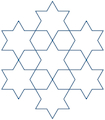
A Mullet of six points within a Circlet of six of the same all conjoined Argent.
As is appropriate to their independent nature, depictions of both badges are somewhat diverse.